


The 2026 Cholesterol Guidelines Are Here: What Your Numbers Really Mean Now
In March 2026, the American College of Cardiology and American Heart Association, together with nine other medical societies, released the first major update to U.S. cholesterol guidelines since 2018. If you've had a physical lately and walked out with a lower LDL target than you remember, or a lab slip for a test you'd never heard of, this guideline is why. As an Internal Medicine physician, I've spent the past several months walking patients through what's actually changed — and just as importantly, what hasn't. Here's the plain-English version.
Why This Update Matters
Cardiovascular disease remains the leading cause of death in the United States, and cholesterol is still one of the most modifiable risk factors we have. Nearly 25 million U.S. adults have total cholesterol at or above 240 mg/dL, the traditional "high" cutoff, and roughly 86 million have levels above 200 mg/dL. The new guideline doesn't change those numbers — it changes how aggressively, and how early, we act on them.
About 1 in 4 U.S. adults has high cholesterol, and the prevalence climbs sharply after age 40
Nearly 25 million adults are above the 240 mg/dL "high" threshold; roughly 86 million are above 200 mg/dL
A lipid panel remains one of the simplest, cheapest ways to catch cardiovascular risk years before symptoms appear
Lower LDL Targets, and They Kick In Sooner
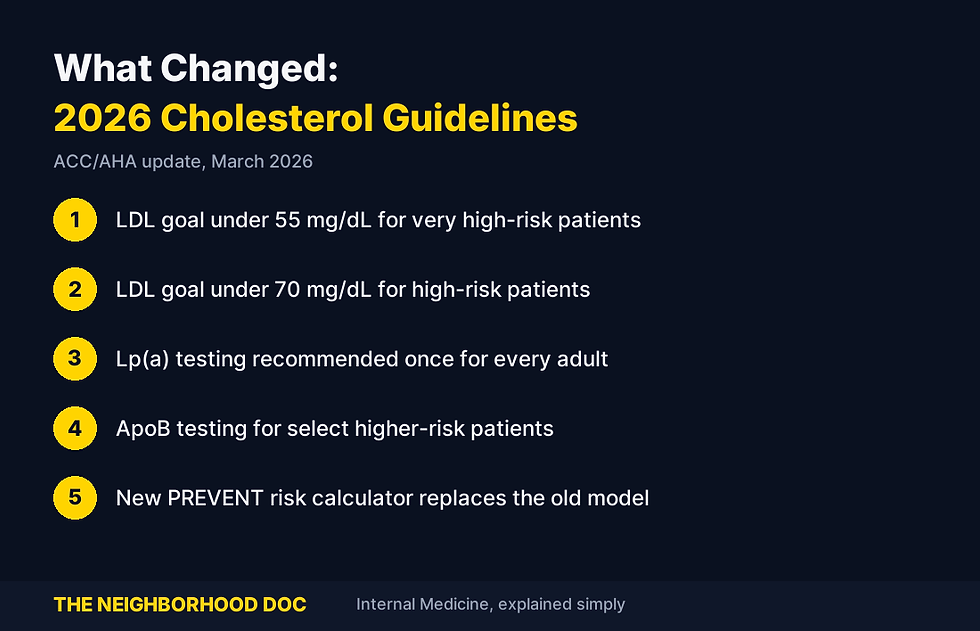
The headline change is a shift toward specific, numeric LDL-cholesterol goals rather than general statin-intensity categories. For patients with established heart disease who are considered very high-risk, the new target is an LDL-C under 55 mg/dL. For high-risk patients with cardiovascular disease who aren't in that very-high-risk group, the goal is under 70 mg/dL. In practice, that means more patients will need a statin plus an add-on therapy to actually reach target, rather than stopping at a "moderate-intensity" dose.
Very high-risk patients (prior heart attack, stroke, or multiple cardiovascular events): LDL-C goal under 55 mg/dL
High-risk patients with known cardiovascular disease, not at very-high-risk: LDL-C goal under 70 mg/dL
Reaching target increasingly means combining a statin with medications like ezetimibe or a PCSK9 inhibitor, not just increasing the statin dose
A New Must-Ask Test: Lipoprotein(a)
One of the most practical changes for patients is a Class 1 (strongest-level) recommendation that every adult have their lipoprotein(a), or Lp(a), checked at least once. Lp(a) is a genetically determined particle that isn't part of a standard cholesterol panel, doesn't respond much to diet or exercise, and can meaningfully raise cardiovascular risk even when your regular LDL looks fine. A high result doesn't mean panic — it means your doctor factors it into how aggressively your other risk factors get treated.
Lp(a) is inherited, largely unaffected by lifestyle changes, and not included in a routine lipid panel
Ask for it once — especially if you have a family history of early heart attacks or stroke
A high result shifts how aggressively your physician treats your LDL and other modifiable risk factors, rather than changing daily habits directly
ApoB: A Sharper Read on Your "Bad" Particles
Apolipoprotein B, or ApoB, measures the actual number of cholesterol-carrying particles in your blood rather than just the total amount of cholesterol they contain. For most people, LDL-C is still a good enough estimate. But for patients with diabetes, triglycerides over 200 mg/dL, or metabolic syndrome, particle count and cholesterol content can diverge, and ApoB gives a more precise picture of risk.
ApoB counts the actual number of atherogenic particles, which can run high even when LDL-C looks normal
Most useful for people with diabetes, high triglycerides, or LDL-C that seems out of step with their overall risk
Not needed for everyone — your physician will decide whether it adds meaningful information in your case
The New PREVENT Risk Calculator
The guideline also formally endorses PREVENT (Predicting Risk of cardiovascular disease EVENTs) as the tool for estimating your risk, replacing the Pooled Cohort Equations used since 2013. PREVENT was built from data on more than 6.5 million adults across diverse populations, adds kidney function (eGFR) to the equation, and no longer uses race as an input variable.
Incorporates kidney function for a fuller cardiometabolic picture
Provides both a 10-year and a 30-year risk estimate, which is especially useful for younger adults whose short-term risk looks low but long-term risk isn't
Drops race as a variable in the risk equation
What This Means for Your Next Visit
None of this should feel alarming — it's a more precise set of tools for a conversation your doctor was already having with you. The basics haven't changed: diet quality, regular physical activity, and not smoking remain the foundation no matter what your numbers say. What's different is that your target number, and the tests used to get there, may be more individualized than they were a few years ago.
Ask whether your LDL-C goal has changed under the new guideline, especially if you have known heart disease
Request a one-time Lp(a) test if you've never had one
If it's been a few years since your last lipid panel, this is a good year to schedule one
The Bottom Line
The 2026 cholesterol guideline lowers treatment targets for higher-risk patients, adds lipoprotein(a) as a one-time test for every adult, gives ApoB and a new risk calculator a bigger role for select patients, and pushes for earlier, more personalized action. It doesn't mean everyone needs new medication tomorrow — it means the conversation with your physician just got more precise. If it's been a while since your last physical or lipid panel, that's the simplest first step.
This blog post is for general informational purposes only and does not constitute medical advice. Always consult your physician or another qualified healthcare provider with any questions about your health or a medical condition.


Comments